
TOOL · DEFINITION & RACI
Obsolescence definition & RACI
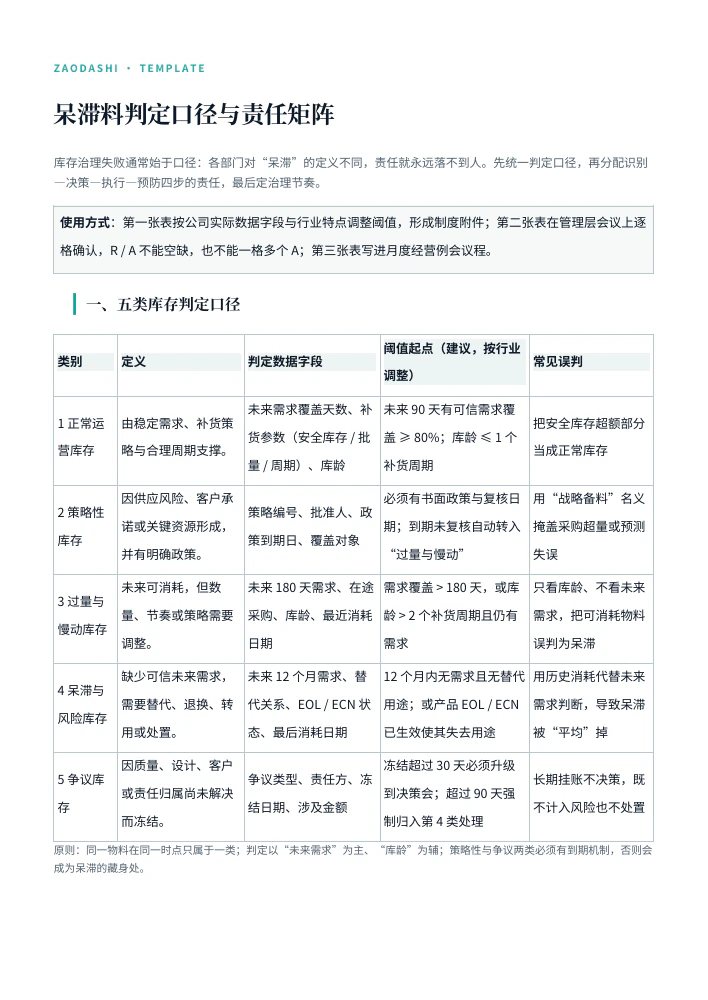
Inventory governance usually fails at the definition: when every function means something different by “obsolete”, ownership never lands on anyone. This template gives the definition rules and data fields for five inventory classes, and the split of responsibility across six functions and four steps.
Version
- Version v1.0
- Updated 2026-09-01
- Language Chinese (PDF)
- Format PDF · printable
- Length Five classes · six functions × four steps
Who it is for
The tool is written for the daily judgments of these roles.
It frames the judgment questions; the conclusion is yours to draw.
You need a definition every function accepts before disposal ownership can be assigned at all.
You need the inventory value broken into an explainable structure, not just a total and an age bucket.
You need to know which stock should move, who decides, and by when a conclusion is due.
What it helps you judge
- Whether a batch is normal operating, strategic, excess and slow-moving, at-risk obsolete, or frozen in dispute.
- Whether your current rules depend on data fields that are unreliable or arrive too late.
- Which of the four steps - identification, decision, disposal, prevention - currently has no named owner.
- Whether risk will regenerate after a clean-up, and which step generates it.
What is inside
The structure of the document.
The list below sets out the chapter structure of the PDF and what each chapter covers, so you can decide before filling in the form.
- Five inventory classesNormal operating, strategic, excess and slow-moving, at-risk obsolete, and frozen in dispute - with the boundary between them.
- Data fields the judgment needsThe material, batch, age, consumption, in-transit and substitution fields each class depends on.
- Threshold starting points and misreadsThreshold ranges to open the discussion with, and the cases where strategic stock is most often misread as obsolete.
- Six functions × four steps RACISales, R&D, planning, purchasing, production and finance across identification, decision, disposal and prevention.
- Turning it into policyHow to adapt the matrix into a company policy annex, and the approval and escalation rules it needs alongside.
How to use it
Ask all six functions to classify the same batch of materials. The largest disagreements mark the real definition disputes.
Confirm field by field whether the required data exists, which system provides it, and whether it updates often enough.
Fill the RACI with your actual role titles. Empty cells are steps nobody currently owns.
Agree a monthly review of classification and disposal progress, and record where newly generated risk came from.
What it will not tell you
The questions below fall outside this tool and need fuller data and interviews.
What it will not tell you
- It does not make the disposal decision - that depends on customer, supplier and contract conditions.
- It does not calculate releasable cash; that needs actual data and an agreed finance definition.
- It does not judge whether safety stock levels are right - that is a replenishment policy question.
- It does not assess delivery problems - use the other tool for that.
NEXT STEP
Bring the operating problem
you most want to change.
Delivery, inventory, operating visibility or a workflow where AI could help. Share your situation and priorities so we can identify a practical next step together.